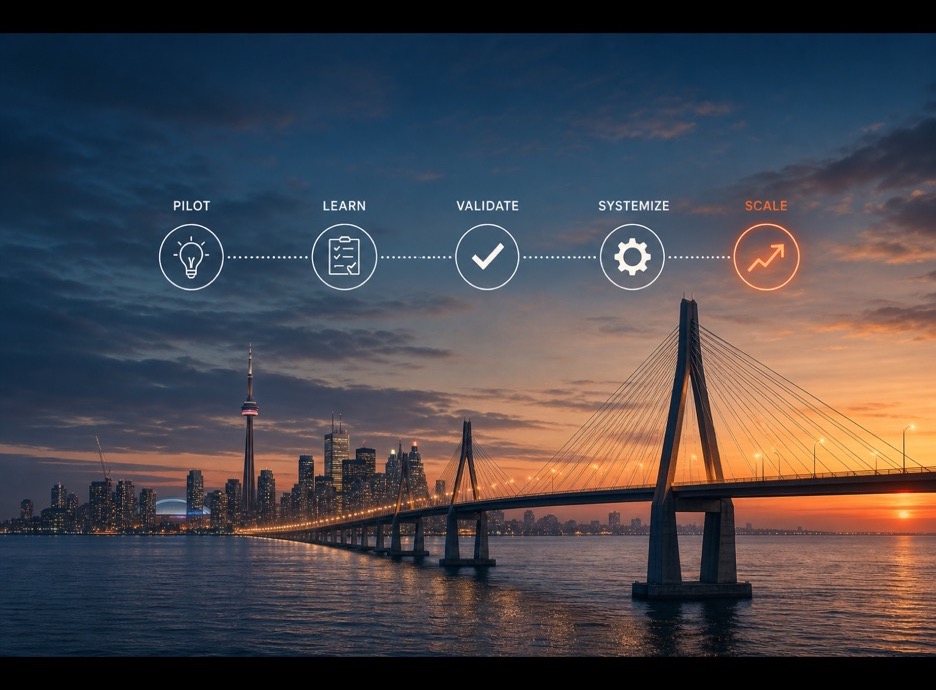

Biotech & Clean Energy innovation intermediary

Connecting solvers
with seekers.

Naru sources, qualifies, funds, and lands biotech and clean-energy innovation across borders. One bilingual desk — from first brief to signed deal.

NDA before the call Bilingual KR / EN desk Paid on closed deals
The Pacific gap

Canada has the funding and the storage. Korea has the technology. Nobody is running the bridge.

KR
Technology
CA
Capital & Ground

We work alongside

KIERKISTETRIKRIBBKIAT · NTBNRC IRAPMitacsSIF · NGenKEPCO E&CKIGAM
Why Canadian operators stall

The capital is here. The right technology partner is the hard part to find.

Canada's clean-economy funding stack is one of the most generous in the world. The bottleneck isn't capital — it's everything between a funded mandate and a working technology.

The hardware bottleneck

Everyone is competing for the same short list of qualified solvents, sorbents, cell chemistries, and EPCs. FEED cycles tie up your engineers for 12–18 months before a single tonne is captured.

The stage-gate wall

A pilot that works in the lab stalls on the climb to 10 MW slipstream and 100 MW commercial. The know-how to bridge that gap sits in a very small global pool.

Your search stops at the border

You scan US suppliers reflexively. Korean R&D — including capture pilots that have run at 10 MW since 2010 — is functionally invisible in English-language deal flow.

What we do

Five service lines.
One bilingual desk.

All services
A

Technology sourcing

We map your technical brief onto Korean GRIs, university TLOs, and scale-ups — and hand you a scored shortlist.

B

Grant & program navigation

NRC IRAP, SIF, Net Zero Accelerator, the NRC × KIAT co-innovation call — sequenced and stacked.

C

Partnership & B2B match

Licensing, technical-services agreements, JV structures, clinical and utility pilots — matched and brokered.

D

Capital & IR connect

Korean strategics and CVCs for your raise; Canadian capital for inbound Korean ventures. Both directions.

E

Forums & trade missions

Curated Korea–Canada roundtables and delegations — the relationship flywheel that makes deals possible.

Build your engagement Most clients combine one or two lines into a package. See how
The model

Cross-Pacific deal specialists.
Backed by named experts.

Every cross-border deal needs three roles: the analyst who vets the science, the dealmaker who builds trust and closes, and the operator who runs it after signing. Our team specializes in the dealmaking — and we partner with a named bench of technical advisors and operating firms for the rest, so every step is led by someone who does that work full-time.

Why this matters
01
Technical Analyst
Named advisor bench & partner firms
02
Dealmaker / Connector Naru
Doors, trust, bilingual negotiation, the close
03
Operator
Your team, post-signing
Numbers that matter

Why the math works.

0%

Korea R&D intensity

2nd in the OECD. Canada sits near 1.7%.

$0B

Canada Growth Fund

Concessional capital for clean-economy deployment.

0%

CCUS ITC (capture)

Refundable. 37.5% on transport & storage.

>0%

Project envelope covered

By stacking Canadian + Korean public capital.

For Canadian operators

Why Korea — and why the window is closing, not opening.

Biotech and clean energy are capital-heavy and policy-timed. Korea is not a generic “Asia option”: it is a concentrated R&D and industrial deployment stack with a formal trade and innovation spine to Canada. The points below are drawn from public frameworks — the same ones we map in The K-Tech Carbon Bridge guide.

Lab-to-Fab

The scale-up & manufacturing powerhouse

While Canada excels in early-stage R&D (TRL 1–4), scaling up to commercial facilities (TRL 5–9) can be a major bottleneck. South Korea is arguably the world’s best at Lab-to-Fab commercialization — with the world-class EPC and manufacturing ecosystem required to turn lab-scale innovation into commercial-scale reality, faster than anyone else.

Friend-shoring

The ideal “friend-shoring” partner

In today’s geopolitical climate, navigating the supply chain between the US and China is risky. South Korea offers the perfect friend-shoring destination — top-tier technology and strict IP protection laws, with a stable and reliable partnership without the geopolitical risks or aggressive takeover threats.

Time is CAPEX

Unmatched execution speed

In North America, project development and engineering cycles can be slow — which directly increases your CAPEX. South Korea’s engineering culture is built on unprecedented agility and speed. Partnering with a Korean firm can cut pilot design and procurement time in half, saving millions in CAPEX.

Dual grants

Co-funding synergy

Partnering with a Korean company doesn’t just bring technology — it brings capital. The Korean government is deploying billions into global R&D for carbon neutrality. With the right partnership structure, we can match Canadian grants (SDTC, IRAP) with Korean government funds — drastically lowering the equity burden and risk for your project.

Why companies should act now

Tax & policy clock

CCUS ITC: full rate this decade

Canada’s refundable CCUS Investment Tax Credit applies to eligible expenditures from 2022 through 2030 at the headline rates (including up to 50% on eligible capture equipment and 37.5% on transport, storage, and use). From 2031 to 2040, those rates are halved — then the credit ends. Capital scheduled after 2030 still matters, but the envelope is strictly smaller.

Source: Canada Revenue Agency — CCUS Investment Tax Credit (clean-economy ITC rules).

Deployment targets

2030 storage and abatement curves

Ottawa’s emissions-reduction plan points to at least ~15 Mt CO₂/yr of permanent storage capacity by 2030 — roughly tripling today’s installed base. Korea’s national framework includes a ~11.2 Mt CO₂/yr CCUS sequestration target for 2030. Both governments are mobilizing capital into the same decade — which means EPC slots, offtake, and qualified vendors lock up early, not at FEED completion.

Sources: Natural Resources Canada — Carbon Management Strategy; Republic of Korea 1st Basic Plan (2023).

First-mover + Korea rulebook

Sourcing arbitrage is temporary

Korea’s Act on the Capture, Transportation, Storage and Utilization of Carbon Dioxide entered into force in February 2025, clarifying licensing, infrastructure, and market rules for CO₂ as a managed resource. That reduces ambiguity for Korean champions — and signals a busier outbound technology and equipment lane as projects firm up. Waiting until “everyone sources Korea” means higher licence fees and picked-over pilot windows.

Source: National Assembly enactment / legal commentary (e.g. Kim & Chang, 2024–2025).

Partnership

Bilateral momentum

The 2023 MOU between Canada and Korea on critical minerals, clean-energy transition, and energy security explicitly names cooperation on CCUS and carbon removal. The July 2024 Canada–Korea Comprehensive Strategic Partnership action plan adds implementation rails for trade, supply chains, and innovation. Programs and ministerial trade missions are aligned with that direction — the practical work is matchmaking and diligence, not writing white papers.

Funding stack

Programs evolve — stacks don’t wait

Non-dilutive pathways shift: for example, SDTC was wound down as an independent foundation in mid‑2024 with programming folded toward NRC‑led successors — a reminder to sequence grants with current owners, not last year’s deck. The NRC IRAP × KIAT call is annual; CCUS ITC eligibility ties to project design choices made before procurement.

Source: Government of Canada announcements; NRC / IRAP program pages.

We are not immigration counsel, tax counsel, or EPC. We route you to primary sources and named counterparties, then run the agent function until close.

Book a Discovery Call
Free digital brochure

The Canadian Operator's Guide to Korean Innovation.

A 10-page field guide most of your competitors haven't read: the Korean CCUS and biotech ecosystem you can't easily Google in English, and a working map of how to stack Canadian + Korean public capital on the same project.

  • The six Korean institutions that actually license technology
  • A worked example: stacking funding on a 50,000 t CO₂/yr pilot
  • Every claim sourced — no vendor catalogue, no fluff

No spam. One follow-up email, then we leave you alone.

Lead Guide · Canadian CCUS Operators
The K-Tech
Carbon Bridge

A Canadian operator's guide to Korean innovation, technology, and cross-border capital.

15 Mt
CA 2030 target
10 pp
Field guide
PDF · Free
Insights

Notes from the desk

All articles

Let's find your crossing.

Twenty minutes. We'll clarify your brief, name the Korean archetypes that fit, and map your funding sequence. NDA first if you prefer.

Services

Five service lines. One desk that closes.

Most Canadian clients buy one or two lines as a package. Prices are bands, shown up front — transparency is a qualifier.

A

Technology Sourcing

We map your technical brief onto KIPRIS, NTB, and the named portfolios of KIER, KIST, KEPCO E&C, KIGAM, KRIBB, KAIST and tier-1 university TLOs. You receive a scored shortlist of 3–5 candidates with redacted technical summaries.

Intake briefKR portfolio scanScored shortlistRedacted summaries
Engagement
CAD 15–35K
Fixed · 4–6 weeks
B

Grant & Program Navigation

The highest-leverage line. We identify and sequence the Canadian public funding your project qualifies for — NRC IRAP, SIF, Net Zero Accelerator, the NRC × KIAT co-innovation call — and structure the Korean-side match.

Eligibility mapApplication timelineKR-side matchStack design
Engagement
5–8%
Of secured capital
C

Partnership & B2B Match

Exclusive licences, technical-services agreements, JV structures, clinical partners, utility pilots, university TLO connections — sourced, qualified, and brokered through signing.

Counterparty pipelineTerm-sheet draftingBilingual negotiation
Engagement
Retainer + fee
Lehman scale on close
D

Capital & IR Connect

Korean strategics and CVCs for Canadian companies raising; Canadian capital and family offices for inbound Korean ventures. Bilingual pitch refinement and roadshow logistics included.

Investor longlistPitch refinementRoadshow logistics
Engagement
3–5%
Of capital raised
E

Forums & Trade Missions

Curated Korea–Canada roundtables, an annual delegation, and senior-executive dinners. The relationship flywheel that turns cold sourcing into warm deals.

Quarterly roundtablesAnnual delegationCurated dinners
Engagement
Sponsorship
+ ticket model

Not sure which lines you need?

That's what the Discovery Call is for. We'll tell you which one or two services actually move your project — and which you don't need.

Book a Discovery Call
How it works

From first brief to signed deal.

No black boxes. Every stage has a named owner, a deliverable, and a gate you control.

1

Discovery

4–6 weeks

We extract the job your technology must do, then map it onto the Korean portfolios that fit.

Deliverable: scored shortlist of 3–5

2

Sourcing & Qualification

3–6 months

Bilingual diligence with our advisor bench: patent strength, FTO, TRL, export controls, KR-government strings.

Deliverable: qualified pipeline

3

Negotiation & Funding

Variable

Term-sheet drafting in KR + EN. In parallel: the NRC × KIAT call, ITC eligibility, SIF pathway.

Deliverable: term sheet + funding stack

4

Closing & Stewardship

12 months

Bilingual execution, escrow logistics, then milestone tracking and royalty audits post-close.

Deliverable: signed deal + stewardship

Commercial structure

You pay for discovery. You pay the success fee when you win.

Discovery sprint

CAD 15–35K

Fixed fee, 4–6 weeks. Filters tire-kickers and pays for our diligence time.

Sourcing retainer

CAD 8–15K/mo

Ongoing sourcing, qualification, and introduction logistics. 3–6 months.

Success fee

Lehman scale

10 / 8 / 6 / 4 / 2% per tranche of deal value. Paid only on a closed deal.

Grant navigation

5–8%

Of non-dilutive capital secured, payable on disbursement.

FAQ

Questions Canadian operators actually ask

Do I need to be technical to work with you?

No — and neither do we, in the way you might think. Technical review is delivered by a named advisor bench. Our job is to route the science to the right reviewer and run the deal. We explain exactly who does what before you sign anything.

How is the success fee calculated?

On total transaction value — upfront plus milestones, with royalties capped. Lehman scale: 10/8/6/4/2% per tranche. It's the industry-standard structure, not something we invented.

Can you really bring Korean and Canadian funding to the same project?

Yes — that's the core of the model. Your Korean partner can claim KIAT international R&D funding while you claim NRC IRAP, the CCUS ITC, and a SIF or Net Zero Accelerator top-up. Stacked, public capital can cover well over half the project envelope.

What happens if the deal falls through?

No success fee on a failed close — the retainer covers work to date. We'll substitute an alternative candidate from the shortlist and keep going.

Why Korea, and why not the US?

The US is crowded and you're already searching there. Korea has world-benchmark R&D, a trade backbone with Canada (CKFTA), a 2024 industrial-cooperation MOU, and institutions actively seeking international demonstration sites. It's the highest-value sourcing pool nobody in your peer group is working.

Sectors

Two sectors. Real depth.

High-value deals, long cycles that favour a patient agent, and abundant public funding on both sides. Pick your sector.

Flagship sector

Clean Energy & CCUS

Korean cell makers, cathode producers, and government research institutes hold the global benchmark in EV battery materials, hydrogen systems, and CO₂ capture chemistry. Canadian battery JVs and CCUS operators are deploying multi-billion-dollar capex right now — and competing for the same scarce supply chain.

Korean source institutions

KIER · KIST · KEPCO E&C · KIGAM · UNIST · KIST quantum/materials groups

Canadian demand

CCUS operators · battery JV operators · hydrogen utilities · advanced-manufacturing SMEs

Deal archetypes

Exclusive licence (Canada territory) · technical-services + option · JV with a cell or cathode maker

Funding pathways

CCUS ITC · NRC IRAP × KIAT · Net Zero Accelerator · SIF · provincial top-ups

Get the full guide

The K-Tech Carbon Bridge — our 10-page field guide for Canadian CCUS operators.

The K-Tech
Carbon Bridge
15 Mt
Ecosystem

The map — and who to call.

Specificity is the whole point. Named institutions, named programs, named bilateral instruments. This is the page that proves we're not bluffing.

KR

Korea side

Layer 1 · Government rails

MOTIE · KIPO · KIPRIS

Industrial policy, patent registry, the search backbone.

Layer 2 · Marketplaces

KIAT · NTB · KOTRA

National Tech-Bank marketplace + bilateral matching programs.

Layer 3 · GRIs & TLOs

KIER · KIST · ETRI · KRIBB · KIGAM · KAIST · SNU

The actual technology source — capture chemistry to biologics.

Layer 4 · Industry & capital

Chaebol R&D · CVCs · law firms

Samsung, LG, SK, POSCO open-innovation arms; Kim & Chang, Lee & Ko.

CA

Canada side

Federal programs

NRC IRAP · SIF · NGen · ISED

Advisory, deployment capital, and the clean-economy ITC stack.

Provincial programs

OCI · Alberta Innovates · BC Tech · Invest Québec

Regional top-ups, sector funds, and pilot-site support.

Universities & research

U of T · UBC · Waterloo · McGill · adMare

Partner offices for joint development and inbound technology.

Trade & promotion

Trade Commissioner Service (Seoul) · Invest in Canada

Government-to-government rails into the Korean market.

The bilateral layer

Where the two sides officially connect

The 2024 Canada–Korea Comprehensive Strategic Partnership, the NRC × KIAT co-innovation call (annual since 2020), and CKFTA — the trade backbone in force since 2015.

About

A small team that knows both sides.

We believe great Korean research deserves great commercialization in Canada — and Canadian industry deserves a real door into it.

The thesis

Why an agent, not a technical brokerage

You don't need a PhD to close a cross-border deal — you need domain literacy and a deal-maker's instincts. The agent opens doors, builds trust, and negotiates. The technical review is delivered by a named advisor bench. Trying to be the analyst and the agent is how deals stall. We chose a lane, and we're honest about it.

How we work

Four principles

  • Source-side honesty. We tell Korean holders what won't work in Canada.
  • Buyer-side patience. Diligence beats speed.
  • Outcome fees. We're paid when deals close.
  • Bilingual by default. Every artefact ships in EN + KR.

We hire slowly. Come meet us anyway.

Analysts, counsel, and program leads — bilingual KR/EN preferred.

Open a conversation
Insights

Playbooks, case studies, and policy notes.

Field-tested pieces we wish we'd had when we started.

Featured · Free download

The K-Tech Carbon Bridge

A 10-page guide to the Korean CCUS ecosystem and the Canadian + Korean funding stack — written for operators, sourced throughout.

The PDF opens in a new tab after you submit your email.

Lead Guide · CCUS Operators
The K-Tech
Carbon Bridge

A Canadian operator's guide to Korean innovation & cross-border capital.

15 Mt
Contact

Tell us what you're looking for.

We reply within one business day. Choose the best-fitting intent below.

I'd like an NDA before we talk.